I still remember the plate. It was a Tuesday in my first vegetarian month, and dinner was a bowl of boiled carrots, boiled potatoes, and boiled green beans, all sitting in a puddle of their own cooking water. I ate it standing up, telling myself this was just what meat-free food tasted like. It wasn’t. The problem wasn’t vegetarian cooking. The problem was that I had never actually learned to cook vegetables.
That’s the thing nobody tells you when you stop eating meat. You can’t just remove the centrepiece of a meal and expect the rest to carry it. Vegetarian cooking tips for beginners usually get framed as a list of ingredients to buy, but ingredients were never my issue. Technique was. Five years on, I’ve figured out that almost every disappointing meat-free meal I’ve made or eaten comes down to one of five fixable mistakes. Here they are, in the order I made them.
1. You’re treating vegetables like a side dish that got promoted
What goes wrong: you cook vegetables the way you’d cook a garnish, then wonder why they don’t feel like dinner. A quick steam, a little salt, done. That works when there’s a roast chicken next to it. On its own, it’s just a sad pile of soft orange things.
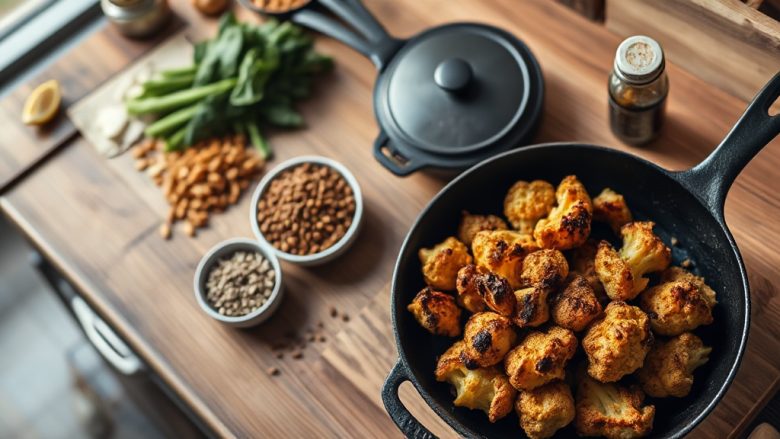
How to fix it: start thinking about vegetables the way you’d think about a piece of meat. That means browning, seasoning in layers, and giving them enough fat and salt to actually taste like something. Roast a tray of cauliflower at 220C until the edges go properly dark, not just tender. Sear mushrooms in a dry pan first so they release their water, then add oil. Char some cabbage. Those browned edges are where the flavour lives, and they only happen when the pan is hot enough and you leave things alone long enough to catch.
The other half of this is fat. Vegetarian food needs more of it than you’d expect, because so much of the flavour in vegetables is fat-soluble. A drizzle of olive oil at the end isn’t the same as cooking with it properly. Use enough that the pan looks glossy, not dry.
2. Your seasoning stops at salt and pepper
What goes wrong: you salt at the end, taste it, and it’s still flat. So you add more salt. Now it’s salty and flat, which is worse.
How to fix it: season in stages, and use more than salt. Salt early, when the vegetables go in the pan, so it has time to draw out moisture and get absorbed. Then taste again at the end and adjust. But the real change is building flavour before the salt stage. A spoonful of miso stirred into a stew. A splash of soy sauce or tamari in a stir-fry. Smoked paprika on roasted root vegetables. A squeeze of lemon over the finished plate, which does something salt can’t. Acid wakes food up in a way that’s almost unfair to whoever’s eating it.
If a dish tastes like it’s missing something and it isn’t salt, it’s usually acid, sweetness, or heat. Try a little vinegar, a pinch of sugar, or a shake of chilli flakes before you reach for the salt shaker again. Nine times out of ten, that’s the gap.
3. You’re leaning on the same three vegetables every week
What goes wrong: you find a rotation that works — peppers, courgette, spinach, repeat — and after three weeks you’re bored of your own cooking. Boredom reads as blandness, even when the food is technically fine.
How to fix it: broaden the base, but do it slowly. Pick one new vegetable a week and cook it a way you haven’t tried. If you’ve only ever boiled broccoli, roast it. If you’ve only ever eaten aubergine in a takeaway curry, slice it, salt it for twenty minutes, and fry it until it collapses. Try a different legume too, because beans and lentils do more heavy lifting in vegetarian cooking than any vegetable. A tin of butter beans, crisped in a hot pan with garlic and olive oil, is a completely different experience from a tin of chickpeas dumped into a salad.
This also solves the protein question that beginners worry about. If you’re eating a mix of beans, lentils, grains, nuts, and dairy or fortified plant milks across the week, you’re almost certainly fine. You don’t need to calculate anything at every meal.
4. Everything ends up the same texture
What goes wrong: a bowl of soft rice, soft beans, soft cooked vegetables, and a soft sauce. It tastes okay on a spoon and then you get halfway through and can’t face the rest. Texture is doing more work in vegetarian food than most people realise, because there’s no chewy piece of meat anchoring the plate.
How to fix it: add at least one contrasting texture to every meal. Something crunchy, something crisp, something chewy, or something creamy to break up the softness. Toasted seeds scattered over a curry. A handful of raw red onion on top of a chilli. Quick-pickled cucumber next to a noodle bowl. Crumbled feta or a spoon of yoghurt swirled through a soup. Fried shallots on anything.
This is the single fastest fix on the list, and it costs almost nothing. If you only change one thing after reading this, change this one. A dish with textural contrast reads as more interesting even when the base recipe hasn’t changed at all.
5. You’re undercooking the base and overcooking the finish
What goes wrong: the onions are still pale and half-raw when the garlic goes in, the garlic burns, and then the whole thing gets cooked for another twenty minutes “to be safe.” The result is a sauce that tastes raw at the bottom and bitter at the top.
How to fix it: slow down at the start and speed up at the end. Onions need real time — eight to ten minutes on a medium heat, not three on a high one — before they turn sweet and jammy. Garlic goes in last and only needs thirty seconds. Spices need a moment in hot oil to bloom, but that moment is measured in seconds, not minutes. And once a dish is done, it’s done. Most vegetarian food doesn’t improve with extra simmering; it just loses texture.
Get a feel for the order of operations and everything else gets easier. Aromatics first, spices second, hard vegetables next, soft ones after, liquid last, acid at the very end. That sequence will carry you through almost any recipe you’ll ever cook.
A simple way to practise all five in one week
Don’t try to overhaul everything at once. Pick one meal this week and cook it three times, changing one variable each time. The first night, cook it as you normally would. The second night, brown everything properly and season in stages. The third night, add a texture on top and a squeeze of lemon at the end. Taste all three side by side if you can, or just note what changed.
That’s how I actually learned. Not from a book, not from a course, but from cooking the same boring bean stew three times in a row and noticing that the version with crispy shallots and a spoon of miso was a completely different meal. Vegetarian cooking tips for beginners are useful, but repetition is what makes them stick. Give yourself a month of cooking the same handful of dishes slightly better each time, and you’ll stop thinking of it as meat-free food. It’ll just be dinner.